
How to read low-click pages that still get impressions
Some pages start getting impressions but still fail to bring meaningful clicks. At that point people often say “ranking is low” and stop there. That is usually too shallow.
When impressions exist, the page is already being tested against real queries. The more useful question is not only where it ranks, but why the search result still fails to win the click.
This post is about reading low-click pages as an operating signal. The point is not to panic over CTR in isolation. The point is to diagnose what the search result is promising, and whether the page actually deserves that click.
1. The common mistake is blaming rank before reading mismatch
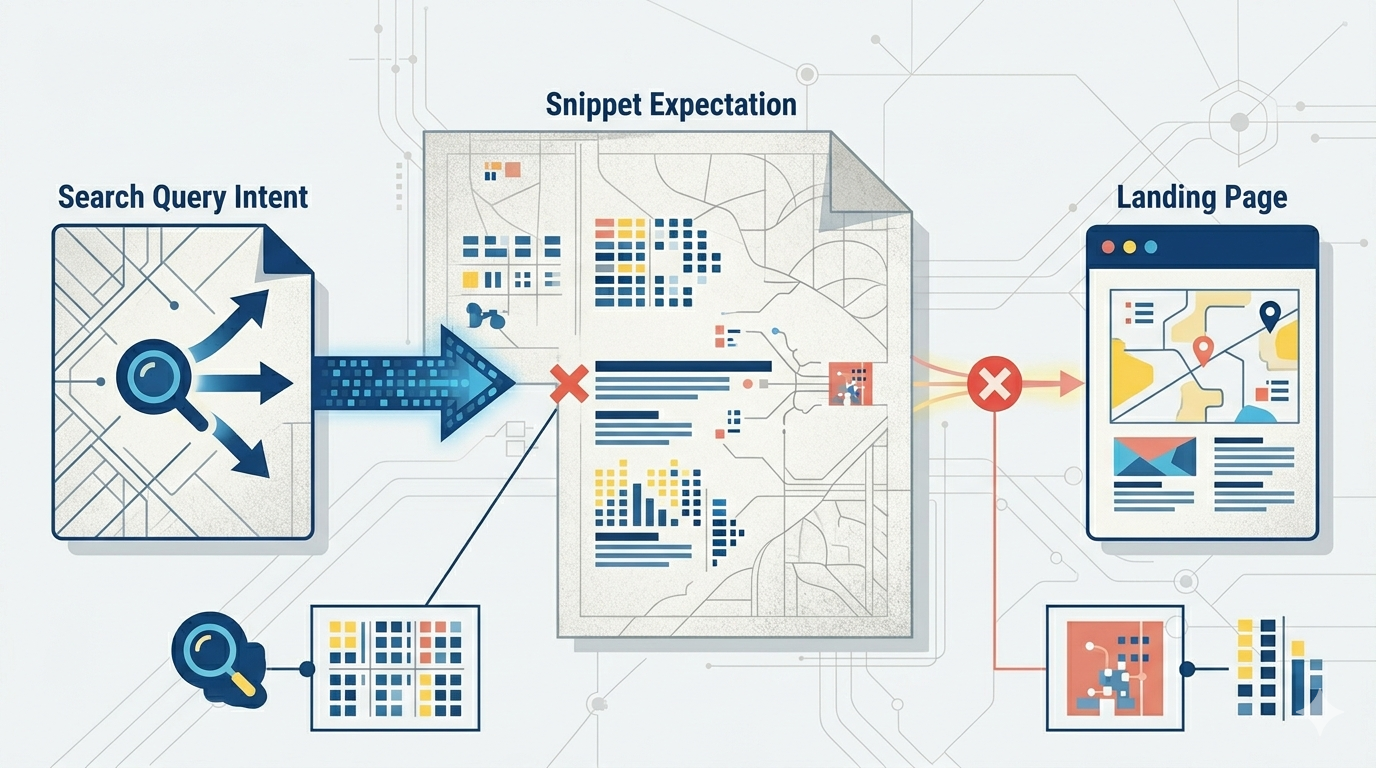
Low clicks do not always mean the page needs more ranking strength first. Sometimes the result already has enough visibility to prove a different issue: the query intent, the snippet expectation, and the landing page are not aligned tightly enough.
That is why impressions matter. They tell you the page is entering the search conversation. If clicks stay weak, the more interesting question is often what kind of conversation the page is entering and whether the result looks like the right answer once it appears there.
2. The strongest diagnosis is reading intent, snippet promise, and landing fit together
This is where low-click pages become worth studying. The weak point is often not a single field. It is the gap between three layers.
First is query intent. What is the user really trying to finish right now? Second is snippet promise. What does the title and description make the result feel like? Third is landing fit. When the user arrives, does the page actually satisfy the expectation the snippet created?
A page can rank and still lose clicks when the title sounds too broad for a narrow query, too vague for a practical query, or too advanced for a quick-fix query. It can also lose clicks when the snippet promise and the page angle feel slightly different. Searchers do not need a dramatic mismatch to hesitate. A small uncertainty is often enough.
This is why rewriting titles mechanically is weaker than reading the three layers together. If the page is being shown for the wrong query shape, the answer may be scope correction, not just a sharper headline. If the query is right but the snippet promise is weak, then title and description need work. If both are right but the landing page opens too slowly or from the wrong angle, the problem moves inside the page.
That is also why two pages with similar rank can behave very differently. One feels like an obvious next click. The other looks close enough to ignore. Search click performance is often won in that difference.
3. Read low-click pages with a short operating frame
A simple frame is enough:
- Is the query the one this page should really own?
- Does the title make the payoff obvious enough?
- Does the description reduce hesitation or add vagueness?
- Would the landing page confirm the promise quickly after the click?
- Is another page on the site a better target for this query?
Those five questions usually reveal more than staring at CTR alone.
4. Do not fix every low-click page the same way
Some pages need a title rewrite. Some need a narrower promise. Some need internal links to support a stronger target page instead of forcing the current page to do the job. Some are simply ranking for the wrong intent and should not be “optimized” into a role they should not own.
That is why low-click pages should be grouped before editing. Separate pages with weak snippet framing from pages with wrong intent match and from pages whose landing experience is the real issue.
5. One concrete example is enough to see the difference
Imagine a page that gets impressions for a query that sounds like a quick checklist, but the current title reads like a broad strategic guide. The page may still be relevant, but the result does not feel like the fastest answer. That page may need either a narrower title or a different target page entirely.
Now imagine the opposite. The title sounds practical and urgent, but the opening section of the page spends too long on general framing. In that case the click may happen, but the landing fit is still weak. The right fix is inside the page, not only in the snippet.
What to do first
Pick one page with impressions but weak clicks and inspect it through the three layers: query intent, snippet promise, and landing fit. If you cannot say which of those three is weakest, do not rewrite the title yet. Diagnose the mismatch first.